Beginner Mat Pilates Workout For Core Strength
A beginner mat Pilates workout for core strength uses five to seven slow, controlled exercises on the floor to train the deepest muscles around your spine and hips. You do not need equipment. You do not need to be flexible. You need a mat, a small patch of floor, and the willingness to move more slowly than you think you should. This article gives you a complete routine, explains exactly how to do each move, and tells you what to watch out for so you do not hurt yourself. It is written for someone who has never done Pilates before and wants a clear starting point.
Why Mat Pilates Works Your Core Differently?
Most people think of the core as the six-pack muscles on the front of the stomach. Pilates trains a deeper layer called the transverse abdominis, which wraps around your waist like a natural belt . When that muscle turns on, it creates pressure inside your abdomen that protects your lower back before your arms or legs move. This is why Pilates teachers constantly tell you to "pull your abs in" or "brace your center." They are not asking you to suck in your stomach. They are asking you to create a gentle, firm wall of tension that stays on while your limbs do other things.
The second difference is speed. Traditional strength training often relies on counting repetitions quickly. Mat Pilates asks you to move with control and to breathe through each movement . You might only do five or eight repetitions of an exercise, but each one requires your full attention. That slowness is what builds the mind-muscle connection beginners need. If you rush, your bigger, stronger muscles take over, and your deep core shuts off. If you go slowly, your core has to do the work.
What You Need Before You Start?
You need a mat. A yoga mat or a thin Pilates mat works fine. If you only have a carpeted floor, that can work too, but a mat gives your spine a little padding when you lie on your back. You do not need a reformer, weights, or bands. A small pillow or folded towel can help if your neck feels strained during the lying-down exercises.
Do this workout barefoot. Socks can slide on the mat, and shoes change how your feet connect to the floor. Give yourself enough space to lie down with your arms stretched out to the sides without hitting furniture.
If you have a known back injury, a recent surgery, or you are pregnant, talk to a doctor or a physical therapist before you try this routine. Pilates is low impact, but it is not a substitute for medical advice.
Read Also: 30 Minute Full Body Workout At Home
The Warm-Up: Spine Articulation
Sit tall on your mat with your knees bent and your feet flat on the floor. Put your hands behind your knees. Inhale and sit up as tall as you can. Exhale and slowly round your back, tucking your chin toward your chest and letting your spine curl backward like a wheel. Then inhale and roll back up to sitting tall, one vertebra at a time.
Do this five times. The movement is small. You are not trying to stretch far. You are waking up the muscles along your spine and reminding your body that your abs can move your bones slowly and with control. If your back feels stiff, make the curl smaller. If it feels easy, pause at the bottom for one breath before rolling up.
The Workout: Five Exercises for Core Strength
1. The Hundred (Modified)
The Hundred is the most famous Pilates exercise. The traditional version is hard for beginners, so start with this modification.
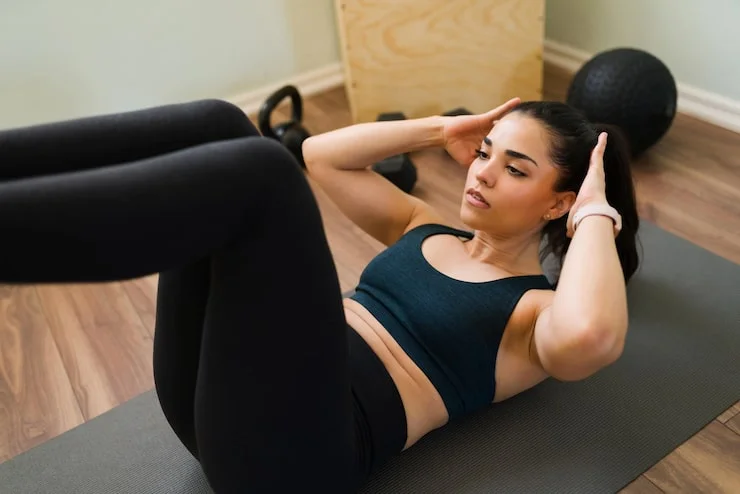
Lie on your back with your knees bent and your feet flat on the mat. Reach your arms down toward your hips, palms facing down and hovering just above the floor. Inhale and gently curl your head, neck, and shoulders off the mat. Keep your chin slightly tucked, as if you are holding an egg under your chin. Do not yank your neck. If your neck feels tight, keep your head on the mat and do only the arm pumps.
Pump your arms up and down about two inches, in a small, quick rhythm. Inhale for five pumps. Exhale for five pumps. That is one set. Do ten sets, for a total of one hundred pumps . The breath is the most important part. The arm pumps are small. The real work is your core holding your spine steady while your arms move and your breath stays even.
2. Single-Leg Stretch
Lie on your back and bring both knees toward your chest. Put your hands on your shins, just below your knees. Curl your head and shoulders up off the mat, keeping your gaze toward your belly. Extend your right leg out long, hovering a few inches above the floor. At the same time, pull your left knee closer to your chest. Then switch: extend the left leg and pull the right knee in.
That switching motion is one repetition. Do ten total, five on each side. The challenge is keeping your lower back pressed into the mat while your legs move in opposite directions. If your back arches off the floor, do not extend the straight leg as far. Keep the movement small enough that your spine stays stable. This exercise teaches your core to hold still while your limbs do something else, which is exactly what your core is supposed to do in real life .
3. Shoulder Bridge
Lie on your back with your knees bent and your feet flat on the mat, hip-width apart. Place your arms by your sides with your palms pressing into the floor. Inhale to prepare. Exhale and press through your feet to lift your hips off the mat. Stop when your knees, hips, and shoulders form a straight line. Do not arch your lower back at the top. Squeeze your glutes and pull your abs in to keep your pelvis level.
Hold for one breath at the top. Inhale, then exhale and roll your spine down slowly, one vertebra at a time, until your hips return to the mat. Do eight repetitions. The movement should feel like your spine is peeling off the floor and then being placed back down piece by piece. If your hamstrings cramp, walk your feet a little closer to your hips. If your lower back feels pressure at the top, lower your hips slightly and focus on pulling your abs in harder.
4. Bird Dog
Come onto your hands and knees. Your wrists should be directly under your shoulders, and your knees directly under your hips. Keep your back flat, like a tabletop. Pull your abs in gently.
Slowly extend your right arm forward and your left leg backward at the same time. Reach long, but do not lift your leg higher than your hip. Keep your hips level. If your right hip dips toward the floor, you have gone too far. Hold for two breaths. Then slowly return your hand and knee to the mat and switch sides. Do five repetitions on each side.
The Bird Dog looks simple, but it exposes every weakness in your core stability. If your hips wobble or your lower back sags, your deep core is not doing its job. Make the movement smaller until you can keep your spine completely still. The goal is not height. The goal is control .
5. Side-Lying Leg Lift
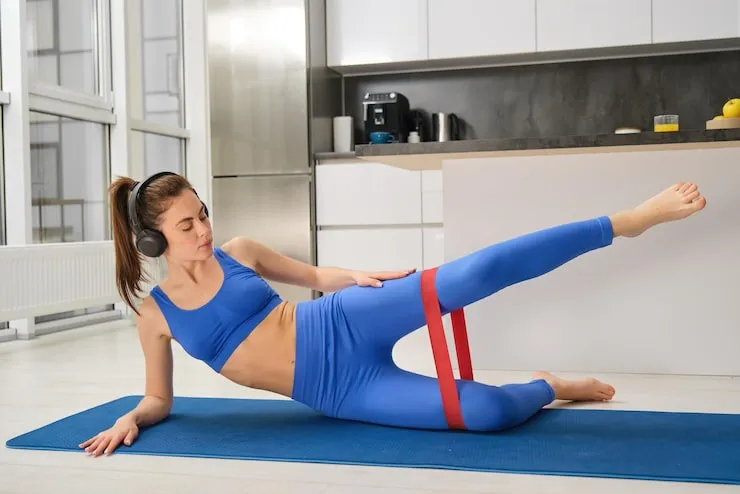
Lie on your right side with your legs stacked on top of each other. Bend your knees slightly, so your hips are at a comfortable angle. Prop yourself up on your right forearm, with your elbow under your shoulder. Place your left hand on the floor in front of your chest for balance.
Lift your top (left) leg about six inches, keeping your foot flexed and your leg straight. Do not let your hip roll backward. Lift and lower ten times in a slow, controlled rhythm. Then switch sides and do ten on the left side.
This exercise targets the obliques, the muscles on the sides of your waist, and the glutes on the working side. The common mistake is rolling the top hip back so the leg can go higher. Do not do that. Keep your hips stacked like a sandwich. If you feel the work in your lower back instead of your side, you are probably rolling. Reduce the height of the leg lift and focus on keeping your waist long.
You May Also Like: What Exercise Burns The Most Belly Fat For Female
How Often to Do This Workout?
Do this routine two or three times per week on non-consecutive days. Your muscles need rest to get stronger, and your core works hard during every other activity you do, from walking to carrying groceries. Two sessions per week is enough to see progress in the first month if you are consistent. Three is better if you have the time.
Do not add more exercises until these five feel familiar and controlled. The biggest mistake beginners make is trying advanced Pilates moves before they can keep their spine stable during basic ones. If you cannot keep your lower back pressed into the mat during the Single-Leg Stretch, you are not ready for a more complicated exercise. Stay with the basics. They are the basics for a reason.
Common Mistakes to Avoid
The first mistake is holding your breath. Beginners often tense up and stop breathing when an exercise gets hard. In Pilates, the breath is what helps your core engage. If you catch yourself holding your breath, pause, reset, and start again with a slow inhale and a long exhale.
The second mistake is moving too fast. Speed hides weakness. If you swing your legs or jerk your hips, your bigger muscles are doing the work and your core is along for the ride. Slow down until the movement feels almost too easy. That is where the real work happens.
The third mistake is ignoring neck pain. If your neck aches during the Hundred or the Single-Leg Stretch, your head is probably too far forward or your chin is jutting out. Tuck your chin slightly and support your head with a small pillow if needed. Neck strain means your form has drifted.
What to Expect After Four Weeks?
In the first week, you may feel your abs in a way you have not felt before, especially deep in your lower belly and along your sides. That soreness is normal. It should feel like a dull ache, not sharp pain.
By the end of week two, the Hundred should feel more manageable. You may notice that you can keep your head up longer without your neck complaining. By week four, the Single-Leg Stretch should feel smoother, with less wobbling in your hips. These small changes are the signs that your deep core is waking up.
Do not expect dramatic visible changes in four weeks. Core strength is an internal skill first. The visible changes come later, and they come faster once you have built the foundation. What you will likely notice first is that your lower back feels less stiff when you sit for a long time, or that picking something up off the floor feels more stable. Those are the real benefits of a stronger core, and they show up before any change in how your stomach looks.
A Final Note on Patience
Mat Pilates rewards the person who shows up consistently and does less than the person who does too much too soon. If you finish this workout and feel like you could have done more, that is a good sign. It means you left room to recover and come back. The goal is not to exhaust yourself. The goal is to teach your body a new way of moving, one slow, controlled repetition at a time.